Skyline Soaring Club in the 20th Century
By Jim Kellett, January, 2000 (edited January, 2014)
Foreword/Acknowledgements
What started as an effort to document some of our own Club's eight year history at the close of the century soon grew into a study of many soaring organizations through which people, machines, and ideas have flowed over more than a half-century. As we follow these people, their machines, and their organizations, we see the same problems and issues, with subtle variations, being dealt with in myriad ways. A thoughtful study of those experiences should be instructive to us as we move into the 21st century.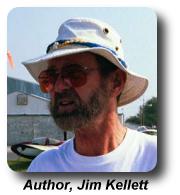
What follows is a brief summary of the author's personal recollections of the events in the Washington, metro area soaring community of the last 50 or so years, plus additional data provided by others who shared in (and in some cases, preceded) these exciting years. This effort was aided considerably by having access to the Corporate records of the Warrenton Soaring Center from 1974 through 1991. I've tried to put faces to many members of this community that I've had the privilege of knowing. Some of the "real lives" of these people prove that soaring becomes a passion for many very different kinds of people - - and gives even more color, I think, to the story of soaring in this area.
The author accepts full responsibility for the accuracy or lack thereof in this narrative, and welcomes corrections and additions from any source. Of the many people who participated in assembling this record, we are particularly indebted to Charles Schwenker, Spencer Annear, Lonnie Patch, Jan Scott, Jack Perine, Rudy Rodgers, Jim Hard, Peter Bacqué, Tony Beck, and Charles Brown for their contributions. Very special thanks are due to Charlie Lee for many outstanding photographs, and to Trish Ward and Ernie Klimonda for many photographs, newspaper articles, and personal recollections. Piet Barber prepared this paper for presentation on the web.
Our Ancestor Organizations
The historical record of soaring in the last half-century includes a genealogy, not only of organizations but also of individuals who can trace their involvement in this sport person-to-person throughout the entire period. It is a startlingly close knit community!
The first post-war club in the area, the Washington Soaring Club, was formed in 1946 at Beacon Field in Alexandria, VA. They operated for about two years, having started with three Pratt-Reads and one LK - all war surplus gliders that had been used to train troop-carrying glider pilots in WWII! The Washington Soaring Club held the first Mid-Atlantic Soaring Contest at Beacon Field in 1949. Due to its close proximity of Washington, the meet received unequaled newspaper coverage. Kim Scribner won the meet, after he thrilled the crowd with low-level glider aerobatics such as slow rolls on tow & outside loops in his Schweizer 1-23 sailplane.
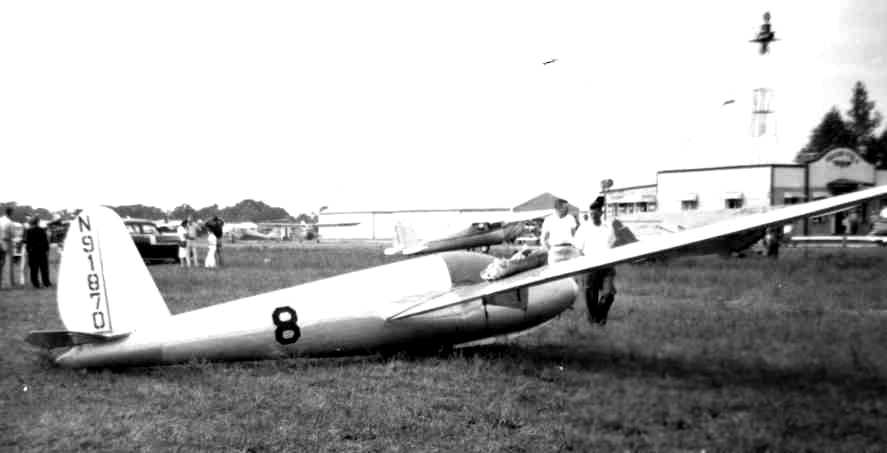
The second Mid-Atlantic was held again at Beacon Field in 1950. The club moved to Martinsburg, WV the next year.
Jack Perine, Nate Frank, and Bill Ebert (among others) formed the District of Columbia Soaring Club in 1948, using one of the three Pratt-Reads that had been used by Washington Soaring Club.
That group of men went on to form the Mid-Atlantic Soaring Association (M-ASA) 1951-2, when Jack Perine (living in Berryville, VA as recently as 2000) led the organizational effort. (An excellent M-ASA history was published by Jack in the February, 1978 CONVECTOR, the newsletter, q.v., of the M-ASA.) M-ASA operated out of several airports, including Westminster in Maryland, and Winchester and Front Royal in Virginia, before settling in Frederick, MD and Fairfield, PA; they now operate only out of their own airport near Fairfield, PA.
A commercial soaring operation, the Capital Area Soaring School (CASS) was created in 1965(?) by the retiring President of the Mid-Atlantic Soaring Association (M-ASA), Gordon Bogora. It first operated out of a private strip near Westminster, MD, and later moved to KJYO in Virginia - then known as Godfrey Field, now as Leesburg Municipal Airport. Other managers/partners of CASS included Ernie Klimonda (who worked at the World Bank) and Lew Tuttle (who worked at the General Services Administration).
It was at CASS that I earned my PPL(G), instructed by Gordon Bogora (and others). Another instructor at CASS, Jan Scott, went on to found the Flying Cow Farm in Lovettsville, VA, which was the home base for the Short Hills Soaring Club that I was involved with in the early seventies.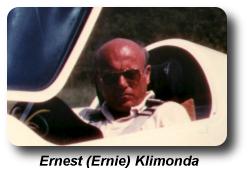
CASS moved from Godfrey Field (KJYO) to Warrenton Airpark (7VG0) in 1969, and was shortly thereafter renamed the Warrenton Soaring Center.
After the untimely death in 1974 (he took his own life) of Gordon Bogora who owned WSC, the assets were taken over by another group of investors led by Jim and Karen Kranda who led WSC until its dissolution in 1991. The National Capitol Soaring Association, which operated a Blanik, was based at the same airport (Warrenton Airpark) as WSC.
Our Club, Skyline Soaring, was formed in 1991 by a group of staff and customers of WSC who purchased some of the equipment that company used when it ceased doing business. Current Skyliner Shane Neitzey led a group that came to include Founding Members Spencer Annear, Phil Jordan, Jim Miles, Jim McCulley, Bela Gogos, Bill Wark, Fred Winter, Joe Rees, Bill Vickland, Bob Neff, Kit Carson, and myself, among others.
The late Skyliner USAF General Dick Ault was among the original stockholders in WSC. Current Skyliners Shane Neitzey, Piet Barber, Phil Jordan (Emeritus), Joe Rees, and Paul Nassetta learned to fly at WSC; Spencer Annear and myself were both later Corporate officers (Treasurer and Secretary, respectively) and stockholders in the company. It was at WSC that I earned my CPL(G) and CFI(G) under the tutelage of people like Ernest Klimonda and Jim Kranda.
Soaring history fans will be interested in the growing number of clubs that have published histories of their own organizations. For example
Philadelphia Glider Council (Started in 1941!!) Soaring Society
Tidewater Soaring Society
Colorado Soaring Association
Mid-Atlantic Soaring Association
Chapter I, The Beginnings
Note: This section borrows heavily from Jack Perine's previously referenced work. A complete copy of his history of M-ASA, which includes the clubs that preceded it, can be read on the Internet.
In the early 1930's, airline pilot Shelly Charles operated an open primary glider from auto-tow at the old Washington-Hoover Airport (where the Pentagon stands today). His flights were usually of short duration before an appreciative Sunday afternoon crowd. In the late 1930's, Peter Riedel, the Air Attaché at the German Embassy operated a "Kranich" sailplane from College Park, MD.
The most prominent pre-war (WWII) club was the Washington Glider Club, which operated a "Franklyn Utility" from Congressional Airport where the Congressional Shopping Center in Rockville is today. One of its members was entertainer Arthur Godfrey.
Another club was the Engineering Research Corp. Club, the builders of the pre-war "Ercoupe" who operated at the old Hybla Valley airport. Memberships were $12, and Jack Perine's first solo while in 2nd year high school was in their primary glider.
Then came the war, and most gliders were taken over by the government, and the owners compensated for them. Peter Riedel's beautiful "Kranich" was said to have rotted to pieces. The war itself greatly helped soaring get off the ground, so to speak. The German invasion of Crete utilizing gliders spurred our military to become glider-minded, and for training purposes purchased quantities of a militarized version of the pre-war Schweizer SGS 2-8 and the Laister-Kauffmann "Yankee Doodle." Designed during the war were the Schweizer TG-3 and the Pratt-Read LNE-1. Eventually the military found that these were all of too high performance to be useful as trainers for troop gliders, and after little use, most were put in storage and sold as surplus during the closing months of the war.
The importance of this cannot be over-emphasized. This availability of two-place high performance sailplanes at a price that many could afford, even in those money-scarce postwar days made it possible for many clubs on a limited budget to form and successfully operate. It may be of interest in view of today's $18,000 sailplanes that the surplus Pratt-Read, brand new and on trailer, sold for $350.
The first post-war club was the Washington Soaring Club, formed around 3 Pratt-Reads and a Laister-Kauffmann. This group operated in 1946-1948 at the old Schrom Airport at Greenbelt, and present M-ASA members who were members of that club are Bill Ebert and Jack Perine. There were about 8 active members, and when the club disbanded after a few years, one Pratt-Read, NG0745, was sold to a newly forming group called the District of Columbia Soaring Club. Nate Frank was one of its members.
To publicize gliding, this club held the first Mid-Atlantic Soaring Contest at Beacon Field on August 4, 5, 6, 1949. Beacon Field was then on US-1 just south of Alexandria, and probably in part due to its close proximity to Washington, the meet received unequaled newspaper coverage. Flying was of a local nature for the benefit of the spectators. Points were given for duration, altitude gain, and spot landings. Kim Scribner of Flushing, New York won the meet. Kim thrilled the crowd with low-level glider aerobatics such as slow rolls on tow and outside loops in his Schweizer 1-23 sailplane. Twelve pilots competed for the championship.
The second Mid-Atlantic was held again at Beacon Field, Virginia on June 18-19, 1950, which Perine won, flying a modified Laister-Kauffmann sailplane.
By February 1951, most local soaring pilots were operating from Martinsburg Municipal Airport in West Virginia where the operator, Mr. Dick Zebley, was especially anxious to have them, providing fee hangars at a modest price. A local cropduster, Mr. Russell Howard, provided tows with a Stearman at a flat $1 per thousand, and after gave us a display of aerobatics on the way down for another tow.
In the winter of 1951, a few area pilots attended an organizational meeting of the then-forming northeastern States Soaring Association in New York City. Its purpose was to promote soaring. On the way home from this meeting they discussed the need for its counterpart here - New York seemed so far off. Jack Perinevolunteered to send out notices for the Mid-Atlantic Soaring Association's first meeting.
The first meeting was held at the home of Mr. Harold Fawcett, 5523 13th St., N.W., Washington, D.C. on Friday the 21st of March 1952. Most of the rest of 1952 was spent trying to recruit new members, and before December we had reorganized twice. By the end of 1952, the fledgling Club numbered 34 members, about 15 of whom could be called active.
At the end of 1953, they had 12 gliders and sailplanes, two of which were owned by clubs within our club, and the rest individually owned; MASA not owning any equipment at all. They were still operating out of Martinsburg and buying tows from the local crop duster. The Club was very active socially, frequently hosting things like open houses and even a dinner-dance!
In early 1954, disaster struck when the crop duster sold his Stearman leaving the club without any towplane. After a short search, the club bought its first corporate aircraft, a Meyers OTW biplane with a Warner 145 radial engine for something less than $850!
M-ASA moved its base of operations around quite a bit over the next decade. When a lack of hangar space became a problem at Martinsburg, they moved to Westminster, MD in 1954. About this time, M-ASA member Floyd Sweet became President of the SSA. (Floyd served for many years as the Region IV Director for SSA.). In December, they moved back to Martinsburg, new hangars having been completed
Initially, M-ASA was intended to be an organization of private owners, but in 1955 the Directors began to think about club ownership of sailplanes to be made available to those who could not afford their own aircraft. This was a turbulent issue, and the cause of some lively discussions.
By 1956, the airspace (and hangars) at Martinsburg was getting really crowded with the arrival of an Air Reserve unit. The FBO terminated their lease, and in October, 1956 the club moved to Winchester, VA. Winchester was not seen as well suited for the club as either Martinsburg or Westminster. The May, 1958 meeting of the club was lively as members debated a move to either Leesburg (where Arthur Godfrey had offered hangar space) or Westminster (where club President MacLeod was the airport manager). There was a split in the club, with four members taking two sailplanes to Leesburg and the rest (including the Meyers towplane) moving in May to Westminster, after a one month "trial" operation by three members at the Front Royal, VA airport.
In March of 1962, Gordon Bogora was elected President of M-ASA. Gordon had a driving personality, rather different from his predecessor. He served as President for three years.
By 1966, the club had once again outgrown the hangar space available at Westminster, so moved again to its present location at the Frederick MD airport where the city of Frederick later built hangars for them. Later still, the club purchased the airport at Fairfield, PA where they still operate a second gliderport.
Chapter II -- Capital Area Soaring School
In the early sixties, the Capital Area Soaring School (CASS) was organized by Gordon Bogora, M-ASA's President, and his wife, Fran at a grass field near Leesburg, VA. While CASS was a full-time operation for Gordon and Fran, there was one other partner, Lew Tuttle, who remained a senior career bureaucrat with the General Services Administration.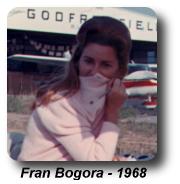
Gordon's hard driving approach was mitigated by his lovely wife, Fran. She was the one who kept the books and often was the person dealing with the customers. Fran still lives in Maryland, with her second husband (another Gordon!).
CASS started at the "old" Leesburg airport, which was a grass strip, located on the north side of Rt. 7, roughly where Rt. 15 now heads north. But it had moved to Godfrey Field (now Leesburg Municipal) with its paved runway and wide sod areas usable by gliders, by 1966, when I moved to Alexandria and discovered CASS in a "Weekender" section of the Washington Post. The land for the Leesburg airport was donated by the then-wildly popular radio and TV entertainer, Arthur Godfrey, who lived in Leesburg and for years frequently hosted his TV variety show from his home there. He kept his personal airplanes - a Baron, a DC-3, and later a jet - at Godfrey Field over the years the gliders were operating there, and it was not unusual to have a cup of coffee with him in the FBO hut. Godfrey was an avid pilot who flew his own aircraft, but to the best of my knowledge never got interested in gliders.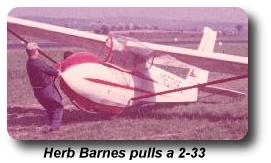
Tony Beck took this picture of Herb Barnes pulling one of CASS's 2-33's on the line at Leesburg. These were the "new" trainers - - replacing the 2-22s that I learned to fly in! (Herb showed up in Leesburg in 1966 with 7 (read SEVEN) full log books of experience and had never had an aero tow! He had learned to fly, and had gotten his commercial (grandfathered to instructor) on auto tow.
Some of the other stalwarts from CASS days include Al Dresner (one of my instructors). Al was a Navy pilot whose accomplishments include once buzzing Sixteenth Street in Washington in a Navy trainer to impress girlfriend Barbara (who became his wife). Al still flies with M-ASA.
I started flying in April, 1966, got my PPL(G) in June, and bought my first glider, one of CASS's 1-26s (N8630R) in August of that year. I recall taking my PPL checkride on the same day as Pierre Mion - Pierre was/is a well regarded artist, who specialized in painting technical subjects. He ghost-painted more than one piece attributed to Normal Rockwell, and one of his beautiful murals still adorns the entryway to the Air and Space Museum. I also took my checkride in a 1-26 - while the FAA examiner watched from the ground!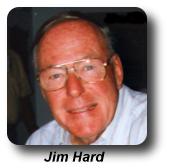
In the fall of 1966, I met James E. (Jim) Hard who had moved his family from the Chicago area to Rockville and a year later to Bethesda. Jim Hard did his Diamond Goal flight back in the sixties in an open cockpit 1-19 from a winch launch! Always a fan of low performance gliders, he holds many records for 1-26 flying. Jim now lives in St. Cloud, MN. He began flying at Godfrey Field in 1966, instructing in 2-22Es and 2-33s and flying towplane. Some of his students were (in addition to myself) Don Ward, Pete Kern, Karl Freienmuth, Pete Garafola, Byron Roudabush, Steve Hard (Jim's son, now an engineer with the FAA in Oklahoma City), Dick Mott, Paul Gearhart, Charlie Lindsay, Don Kiscaden, Frank Linder, Bill McClure, Ernie Klimonda, Ed VerHoef, Jack Hessian, Greg Niswonger, Tony Beck, Oran Nicks, Chris DeMuth, and Willy Peterson. Jim has a clear recollection of Oran Nicks trying to make it back to the airport on a local soaring flight, flying over three perfectly landable fields and hitting the airport fence doing minor aircraft damage and causing Oran much embarrassment. Steve Hard soloed on his 14th birthday at Leesburg.
My first partner in a glider was a pathologist at Georgetown (I forget his name) who never flew the plane once during our short partnership! Jim Hard bought my partner's share in N8630R, and we both made cross-country flights to Pennsylvania and locations to the south. In the next few years I got my Silver badge in our 1-26.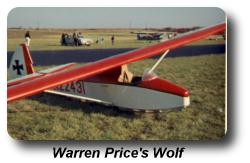
Leesburg was where Hard made his first and only flight in Warren Price's Wolf. (Jan Scott bought Warren Price's Wolf and restored it to the original German Nazi appearance. It is now on display in the Wasserkuppe museum in Germany, albeit without the swastika (which was added to the vertical fin after this picture was taken.) This was the second of two built in this country; the first one is the one at NSM.)
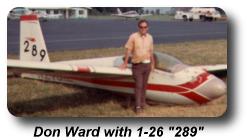
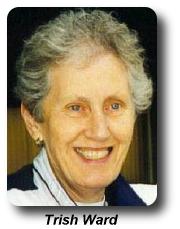 Trish Worthington had learned to fly gliders at her home in England. She came out to fly with CASS while she was working at the British Embassy in Washington. Trish worked as a "line boy" at CASS. Interestingly, Trish strapped in one new customer - Don Ward - on his first flight at Godfrey Field. Later, they married ten years to the day that she'd had her first glider flight in England! They had one son, Peter; Don passed away in 1996, and Trish still lives in Leesburg. Don owned a 1-26 (No. 289) in a partnership with Tom Adamczyk. Later, Don sold his share to Skyliner Bob Collier, who subsequently bought out Tom's share and has been flying it ever since.
By June of 1970, one of the instructors at CASS, Jan Scott, had developed his own gliderport near Lovettsville, VA - Scott Airpark, also known as the home of "The Flying Cow". Scott Airpark, in turn, became the home in the early seventies of the Short Hills Soaring Club that included, including myself, Jack Hessian, Gordon Dicker, Frank Sears, Jim Hard, Karl Ockert, and others. SHSC bought a 1-23, but the club disbanded when its only plane crashed in 1973 or 1974. Some of Jim Hard's students at Scott included Gordon Dicker (winch tow checkout), Bill Getsinger, Fred Balmer, Hunter Robinson, Tim Ettridge, Karl Ockert, and Bill Gunnison who got his C Badge on his first solo flight. There were many ridge soaring flights on the Short Hills and quite a few wave flights originating at Scott Airpark. Frank Linder, Frank Sears, and Jim Hard owned a Standard Cirrus, which flew out of Scott in 1973-74. Unfortunately, it got wrecked sometime before July 1974.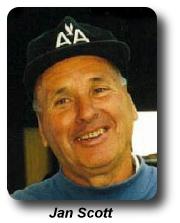
Like so many clubs and companies involved with soaring, CASS felt an obligation, driven in part by enlightened self-interest, to promote soaring to young people. Many kids came out to Leesburg to work on the flight line in exchange for free flying. On September 21, 1968, there was a very positive newspaper article about their support of young people in Washington.
Special Section, Newspaper article from September 21, 1968 [Go There Now]
I got my first few seconds of fame in July of 1968 when I was surprised by seeing my picture on the front page of the Loudoun Times-Mirror!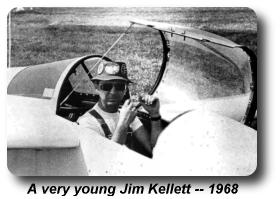
In 1969, Godfrey Field got rather too busy with sharply expanding power traffic, so CASS started operating at Warrenton Airpark in early October of that year. The Company was then owned by Gordon Bogora and Ernest Klimonda, who had purchased Lew Tuttle's share in the company.
Ernie Klimonda was one of the more interesting people (among many very interesting people!) involved in soaring about this time. Born in a village near Prague, he grew up during the war in German-occupied Czechoslovakia. He learned to fly gliders as a youth. He joined the French Foreign Legion and fought the communists in VietNam when it was still a French colony - becoming one of the original VietNam vets! Later, he married a French woman and lived in Morocco for some time before immigrating to the US where he worked at various places as a travel agent. (Fluent in many languages, he enjoyed working as a tour guide in Washington after his retirement.) He was a very active glider pilot, and owned a SGS 1-34 and later an ASW-19; the same ASW-19, that is now owned and flown by Jim Garrison. He was also a power pilot, a CFI(G), a tow pilot, and a DPE. (It was Ernie who examined me for my CPL.) He was and is a most skilled photographer, having won many awards in photography contests over the years. Many were taken of the soaring community. Ernie retired from the International Monetary Fund, and now lives in Fairfax.
The move to Warrenton was heralded in a local newspaper article in October of 1969 about Warrenton (and Fauquier County) becoming the home of a prominent gliding company. Ernie was one the instructor who was interviewed by a local reporter and who, of course, was treated to an introductory flight. One of the pictures published in the paper was from the front seat of a 2-33 - - pointed straight down at a farmhouse - - on the back side of a loop that Ernie did for him!
Special Section, Newspaper article from October, 1969 [Go There Now]
Back in those days, prices were a LOT different! CASS advertised introductory rides for $9, and a package deal for $375 that was supposed to take you all the way to a PPL(G). Ernie and Gordon were pretty good about scrounging up "free" advertising in the local newspapers, including the Washington papers.
Warrenton Airpark was, and still is, owned by Charles Beatley, a retired United Airlines pilot who for several terms was also the mayor of Alexandria, VA. He also did a lot of towing for WSC (see below), and served as a Director for the lifetime of that Company.
Chapter III -- Warrenton Soaring Center
While I was gone on a sabbatical in 1973-4, CASS owner Gordon Bogora tragically died at his own hand. A group of investors soon stepped up and purchased the assets of the company, and WSC was formally incorporated in August 13, 1974. The initial Board consisted of Henry E. Otten, Kenneth Quinlan, James Kranda, Richard Ault, Ronald Miller, Frank Gallegos, Charles Beatley, Harvey Paige, and Richard Secord (the Richard Secord of Watergate fame). These people financed the startup of the new company out of their own pockets, plus some significant debt through commercial loans. The first President was Harvey Paige; Secretary was Richard Secord, and Henry Otten served as Treasurer.
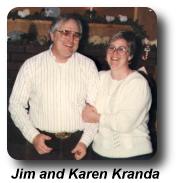
Jim Kranda was the prime mover at WSC, serving as the President of the Corporation for most of its life. Jim and Karen lived just across the road from the airport in Warrenton both had government jobs, his in Washington and hers in Bethesda, so for years they had a major commute. Jim was also a towpilot, CFI(G), and a DPE. Karen was the company's administrative backbone, first as girlfriend and later as wife.
Company included some other interesting people. By 1977, Gallegos, Secord, Miller, and Quinlan were gone and one Marine Col. (now General) Charles Pittman was a stockholder/Director. Chuck Pittman was the Marine officer who led the ground forces in the ill-fated attempted rescue of the Iranian hostages. 1979 saw the addition of Dick Edge to this group.
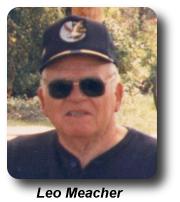
Leo Meacher, the first customer at the Warrenton Soaring Center, was a retired Navy airman with an impressive WWII combat flying record. He had made several hundred (!) combat carrier landings, and had been involved in many of the historical battles in the South Pacific, including the Battle of the Coral Sea, and was awarded the Navy's highest medal, the Distinguished Flying Cross. When he passed away he was interred with full military honors (including a Navy 'missing man' fly-over) at Arlington National Cemetery.
Leo was one of the major contributors to both Warrenton and the early Skyline years. Both Leo and his wife Linda [Lawrence] were towpilots and CFIs. Leo ran the weekday operation at Warrenton in its closing years, and was later primarily responsible for developing the move to 8W2 (New Market Airport) in 1991. He retired to Placitas, NM.
By 1980, the Directors were Jim and Karen Kranda, Charles Beatley, Joe ("Dick") Edge, Harvey Paige, Taylor Hines, Phillip Mouser, and Don Robb (now the owner/manager of the highly successful flight school, Av-Ed, operating out of Leesburg Muni). Don Robb was also an active member of M-ASA.
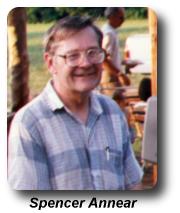
Spencer Annear became a tow pilot at WSC in November of 1979 and an instructor there in October of 1980, marking the first participation by an individual who would remain involved throughout the entire transition from WSC to Skyline Soaring Club. In 1983, he (and Richard Matsko) became stockholders-Directors. In 1987 he became Treasurer of the Corporation. (I bought into the Company in 1986, and shortly thereafter served as Secretary.)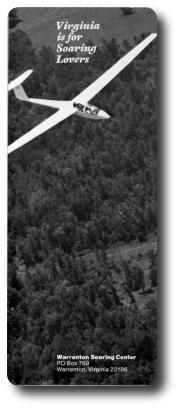
Later, as one of the Club's founding members, he is properly credited with being the architect of the Club's unique organization and its shepherd during his six year Presidency. His outstanding service to the Club was recognized at the 1998 Annual Meeting with the Club's first (and only) Outstanding Service Award and plaque. Spencer is now inactive in the Club, living in Alexandria, VA, and flying floatplanes.
It bears noting that WSC was a company that acted a lot like a Club from the very beginning. Most of the stockholders were also members of the Board of Directors (others were spouses anyhow)! That made for some interesting Board meetings, to say the least. Even when I bought into the company in 1986, there were still long, passionate discussions of just that the purposes of the Company were. The perceptions of the stockholders ran the gamut from a commercial enterprise expected to provide a return on investment to the stockholders to a legal way to have others pay for the stockholders and directors' own recreational flying. In my opinion, this was never satisfactorily resolved, and the failure to achieve either objective was one factor contributing to the burnout of the owners and the company's eventual failure.
Phil Jordan is a graphic artist that, for a while, did the layout work for Air and Space Magazine. He was a major player in the design of US Postage Stamps. Phil and I, with Phil's son as photographer, were the subjects of one of the Company's informational brochure. We were flying the K-21 on the cover, and Phil's son, in the back seat of the Company's PA-18 towplane, took the pictures.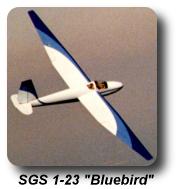
I had sold my 1-26 just before taking off on a Sabbatical in 1973, and bought a 1-23H when I came back in 1974. It was kept at Warrenton. Later, I leased out the ship to several people who earned their early badges in it (e.g., Jim Garrison). I earned my Gold distance and Diamond altitude in this ship - N10388. I painted it three shades of blue, using an original design by Scott Callander (an artist who flew with us) that was very striking. For obvious reasons, it was nicknamed Bluebird. Peter McLean now flies it at the Mohawk Valley Soaring Club in Connecticut.
The National Capitol Soaring Association flew a Blanik at Warrenton. Shane Neitzey was also very active in that club, flying the Blanik a great deal until it, too, was seriously damaged in an accident, signaling the demise of still another Club.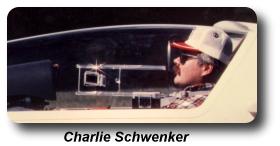
Charlie Schwenker started soaring in 1975, and became a CFI(G) and later, in 1984, a Director of the Company. He is shown here in his LS-1f, one of the first glass gliders to operate at WSC. Charlie Flew a Pitts and later an Extra out of Culpeper for some time, and was a frequent aerobatic pilot at the Flying Circus airshow venue in Bealeton. He also won several acrobatic contests before he (and his wing-walking partner, Jane Wicker) in June, 2013 while flying in an airshow in Dayton.
Charlie Schwenker remembered Harvey Paige's t-shirt - "Lose Not Thine Airspeed, Lest the Ground Rise Up and Smite Thee". Harvey was a docent at the Air & Space museum, and would say things like "when I first flew in a Ford Tri-motor like that one, I was only ?? years old ..." I'm sure Air & Space was happy to have someone who grew up with the airplanes that are on display. He and his wife later moved to the San Juan Islands in the Pacific northwest.
In 1974, the Warrenton Soaring Center at Warrenton Air Park had a canvas awning 'office' set up right next to the fence along Route 619. rom the parking lot, customers had to cross the active runway to get to the 'office'. The office trailer showed up about 1976. In the winter, we would take that office trailer to Front Royal and Orange while the Airpark was too wet to fly. The wooden lean-to that was constructed over the trailer many years later was mostly because the trailer leaked, and partly to give some shade.
The Soaring Center was a Schweizer dealer, which helped in buying parts and planes. Typically, the company would buy the minimum aircraft from Schweizer required to maintain its dealership status, and then sell off one or more of those in service to others. In 1975 or thereabouts, the company sold a 2-33, 1-26, and a Citabria to Skyline Aviation, a commercial operation owned by Charles Brown (currently the Chairman of the Warren County Front Royal Airport Commission) and Wayne "Speedy" Lloyd, in Winchester, VA. Skyline operated a glider program for a couple of years; it's not known what happened to the equipment when they ceased glider operations. Charlie was a CFI(G) and a DPE. It was during this time, in Winchester, that Spencer Annear, the Club's second president, earned his glider ratings, and was examined for his CPL(G) by Charles Brown!
In the mid-seventies, two groups of WSC clients got together and purchased ASK-21s. There were some really incredible tax breaks at that time, allowing owners of leased aircraft to depreciate them in just a few years. One group that bought N774KS, included myself, Cecil Arnold (who also owned a 1-26), Gary Quinn, and Judy Silverman. The second group purchased N341KS the one that Skyline still flies and was composed of Fred Winter, Bob Neff, and myself. (By the way, the "KS" in the tail numbers of these planes stands for "Karl Streideick" who was at that time the Schleicher dealer in the US.) These two planes made a huge difference in the way the Company operated, and soon became the favorites of both instructors and customers. With the end of the tax write off period, one group (N774KS) sold their plane to California City Soaring and I sold my share of N341KS to Fred and Bob.
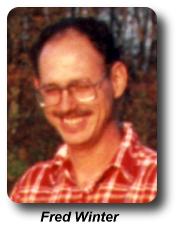
Fred Winter is one of the often unsung heroes of the Club. He learned to fly with the CAP (in power) as a kid. With his partner Bob Neff, he had leased his ASK-21 (N341KS) to WSC. When the Club was formed, they both became founding members, and Fred took the lead in maintaining the aircraft almost single-handedly. His selfless and generous support over the years has been a critical factor in the Club's continued success, and is one not fully appreciated by the newer members. In real life, Fred is the technical master at CBS news. He has some neat behind-the-scenes stories to tell!
Tows were done with 150 hp PA-18 Super Cubs and Leo Meacher's Citabria (also owned by Carroll Rands). Later we put a 180 hp engine on a Cub, and later still bought the two Pawnees. On hot days, everyone wanted the latest, greatest, highest horsepower tow plane - Even if it was only a 1-26 needing a tow. Wasn't a bad idea, though, given the trees around the approaches!
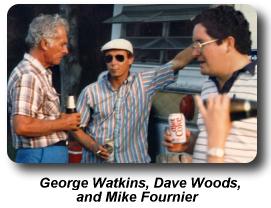
Some of the major supporters at WSC that aren't active in soaring around here now include Dave Woods, in the center of this picture. For a while, Dave was a very active ASW-19 pilot, and was a regular ground manager for the Company. He went to California to work with the late George Watkins (left) for a while at Crystal Soaring, after George and his wife Monica bought the Gliderport at Warner Springs, CA. The guy on the right in this picture is Mike Fournier, a corporate pilot and a regular tow pilot for the Company. (Mike was a tow pilot for Skyline until health problems precluded his flying.)
George Watkins retired as a navy Commander. He was the first naval aviator to make 1,000 carrier landings and was for a long time the navy's "master bagger," the pilot with the most carrier traps, a big deal among the boat people. Leo Meacher was "Gorgeous George"'s first squadron commander! When George came on board the carrier, Leo took one look at his vainglorious head of hair and said, "get a haircut!"
Richard 'Old Dog' Wolters stopped by one day Just visiting. We normally sold his books, but I couldn't find one of them in the trailer for him to sign that day.
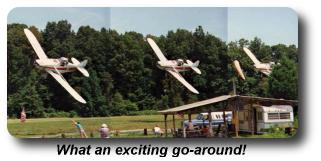
Here's how to NOT do a pattern! The Company's towplane (our very own 66) is shown breaking off an approach to land to the west by turning left onto the SW runway at the intersection! You can see a 1-26 that was blocking the runway in the last picture . . . also the people at the office who are understandably excited!! Charlie Lee took this interesting sequence of pictures.
The airport had two runways running roughly SW-NE and E-W. Each was a little over 2,000 feet long; the SW-NE runway terminated in about the middle of the E-W runway, and it was common practice to land to the west, stop in time to be in position to launch to the SW. But the intersection was close to 100' lower than the opposite threshold, and the E-W runway was entirely surrounded by trees. Warrenton Airpark was (and is) a challenging airport, to put it mildly. Over the ca. 15 years WSC operated there, several aircraft were destroyed and several pilots suffered injuries, some serious, and with two fatalities. I personally believe that the airport became increasingly unsuitable for gliders over the years as the trees on and around the facility grew and as the continued failure to get hangars constructed led to increasing maintenance costs for the company.
Derek Piggott was here for the SSA convention, and flew at Warrenton with some of the staff & customers and with typical British reserve, called it a "difficult place to land."
There were more than a few "kids" that worked their way to their first pilot's license at WSC, with or without a lot of aid from the McClain Foundation. They worked for credits as go-fers. They include:
● Matthew Jones, started as a line boy in 1988 at age 14 and started flying gliders then. He got hired by Continental Express when still 21 and made Captain on his 23rd birthday in the EMB-120. At the time he was the youngest airline captain in the country. He was promoted to captain on the EMB-145 Regional Jet at 24 and at that time was the youngest jet captain in the country. At 25 he was a check captain on both the EMB-135 and 145. (Matthew's dad, retired AF pilot Bill Jones, was for a while chief glider instructor at the University of Illinois and assistant director of that school's flight Program and Bill got his first glider ride from none other than WSC's Ernest Klimonda !)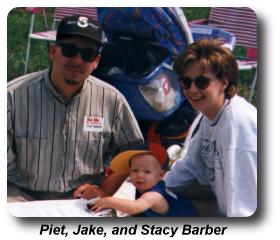
● Piet Barber used to have his Mom drive him to the airport, because he did not have a driver's license. There he could legally fly our gliders by himself! Piet later became a professional computer wizard, is married (Stacy), now has four kids, lives in South Riding, and became a very active pilot and instructor and officer of our Club.
● Steve Szalai (son of Bela Szalai who flew an LS-1 at WSC) went on to become an airline pilot, first with Air Transport International and, as of 2014, as First Officer with American.
● Mark Grainger got his glider pilot's license at WSC, then went on to fly fighters with the Air National Guard and then moved to Trans World Airlines and later with Delta.
● Bruce Thomas, another "A.P.E., or Aircraft Placement Engineer as lineboss Dave Woods would call them, went on to fly 757s with FedEx.
● One of the notable "Warrenton Kids" who remains as an active Skyline Soaring Club member was Shane Neitzey. After learning to fly gliders at WSC, he went on to get power ratings, a CFI(G) rating, and did a tour as a pilot for American Eagle. (In the picture, he's shown in uniform, with his wife, Valerie). Shane was the first volunteer to organize the Club in 1991, and he led the effort during those crucial months leading up to formal incorporation. He has earned all his diamonds, became a CFI(G), and eventually became an active competition pilot. As of 2014, Shane lives in Broad Run, VA with his wife Valerie and their two kids, where he owns and operates a sign company.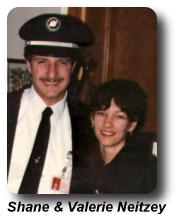
Bert Schmutzart flew his BS-1 glider for the first time at Warrenton. It was his own design, and he had built it in his townhouse. It had a high lift low speed airfoil, which seems like a good idea for a glider, but apparently the wing started to lift before the elevator was effective, resulting in some initial take-off excitement. It also had flaps for landing, but the actuating mechanism was not as strong as it could be, and under air load the flaps would not deflect fully. The result was that the first landing was l o o o o n g. Approach to landing on runway 4, past the not yet built hangars ~5' in the air, used the entire runway, turned left, and landed on runway 30. Bert took it home for more adjustments, and it worked better later. I don't know if he still has it or not.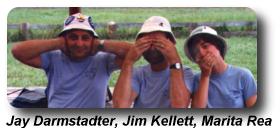
Not exactly kids, but several WSC pilots went on in later years to become flight instructors at other Clubs. Here are a couple. Hearing no Evil is Jay Darmstadter, in 2014 an active instructor at the Shenandoah Valley Soaring Club in Waynesboro, VA where he restored a Ka-6. I'm Seeing No Evil; Saying No Evil is Marita Rea who's a flight instructor at Tidewater Soaring. Marita's married to C.B. Umphlette, with whom she shares a 1-26. Both these instructors are regular participants in Vintage and Classic rallies.
There was a strong sense of community among the pilots who flew at WSC. In many ways, operations were more club-like than company-like. There was always a major spontaneous picnic every Saturday during the season, with as many as 50 or 75 participants.
Lots of pranks, too. There were two young men in the Dobbins family who learned to fly there; the father made a rash bet with one (John) that he (the student) couldn't accomplish some soaring milestone or another (I forget just what), or he (the father) would "kiss his ass". Well, John did it. So at the next Saturday picnic, John dropped his drawers in the middle of the runway and his father kissed his butt!
We also had lots of interesting staff. (Yes, staff - - because of an IRS ruling, we had to pay "employees" rather than just give them bartered use of the equipment.) I can remember getting "paychecks" for $10 or $15 for a month's work! Many were military officers on rotation to the Pentagon. A couple of notable employees were Marine Colonel (later General) Chuck Pittman, who led the ground forces in the attempted rescue of the hostages in Iran and Admiral George Strohsahl, who later was the head of the Point Mugu Missile Test facility in California. Tow Pilot George Watkins was the brother of Secretary of Energy Jim Watkins (under President Reagan). (George now runs an aerobatics school in California.) Air Force Brig. General Dick Ault, who occasionally still tows for Skyline, was a very active tow pilot at WSC (in addition to being an owner and officer of the company).
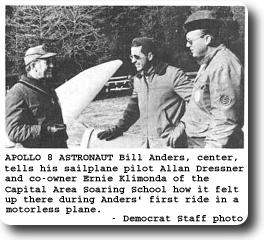
At least two astronauts flew with CASS/WSC. One was Major Tom Stafford, commander of the Apollo-Soyuz Mission, and the other was Bill Anders of Apollo 8, who was taken for his first glider flight by Al Dresner on December 11, 1969. The newspaper photo shows CASS co-owner Ernest Klimonda also. The article appeared on December 11, 1969.
Special Section, Newspaper article from December 11, 1969 [Go There Now]
One of the more painful incidents at Warrenton occurred on September 8, 1979 when William McClean died in a towplane while attempting to aerotow a glider out of the field immediately adjacent to the runway at the airpark. Several current Skyline members were present, including Bill Vickland who was flying the glider being towed. A group of pilots including Cecil Arnold, Jim Kellett, Al Dresner, and others later formed a 501(c)(3) Corporation, the William McClean Memorial Foundation, which was, for a while, actually on the Federal United Way Campaign donors list. The Foundation provided financial assistance to young people to learn to fly gliders. When the tax rules changed a few years later, the Foundation disbanded, turning over its assets to the Collegiate Soaring Association and the National Soaring Museum.
1991 was a dramatic and traumatic year for the Warrenton group. Having finally been convinced of the unsuitability of Warrenton Airpark, the Board reluctantly decided to move operations, and in January the Corporation was implementing its planned move to the Front Royal Airport.
However, in February, the stress of leading the company was causing a great deal of burnout among the Directors. Two working groups were established, one to research the disestablishment of the Corporation (which I chaired) and the other to research major changes in management, which would reduce the onerous workload on the Directors (which Phil Mouser chaired).
In March, the Board reconsidered its planned move and negotiations with IAD had led to agreements to operate our towplanes w/o transponders in the "veil". In April, the planned move to Front Royal had run into snags, and the operation continued at Warrenton Airpark. The Company also decided to hire a full time manager, and if none could be hired by May 1, that the Corporation with close its doors. By June, the last frantic efforts to save the Company had played out and the Board was committed to disestablishment.
The Corporation's Board continued throughout the remainder of 1991 and early 1992 to complete the disestablishment of the company and distribute the proceeds of all sales to the stockholders. The last meeting of the Board was on March 18, 1992.
Footnote: Warrenton Airpark, first established in 1937, continues to be an active airport. Now (2015) owned by Thomas Richards, it is the home of a very successful skydiving operation, and home to about 50 aircraft, mostly ultralights and parasails.
Note: There is an on-line collection of a couple hundred photos (some of which are shown in the article above) from this era - click HERE.
Chapter IV -- Skyline Soaring Club, Getting Started, New Market
On June 15, 1991, the Corporation announced at a special invitational meeting of its clientele the company's decision to terminate business, and its encouragement for a group to form a Club with some of the assets. At that meeting Shane Neitzey volunteered to take the lead in setting up such a group. Over the next few weeks, three of these people - Neitzey, Leyendecker, and Postma - worked diligently to solicit charter members who would put up the initial money, and to start framing the organization of the new club. Without the selfless work of these three people in the summer of 1991, Skyline Soaring Club would have never been born.
By August 13, 1991 Shane had led the first several meetings of the organizational group and they had selected an Acting Board of Directors consisting of James Postma, Leo Meacher, Lonnie Patch, Bill Vickland, and Bob Leyendecker. Lonnie Patch was a regular with WSC, and owned a 1-26 in partnership with Ralph Hendrickson. She was the recognized doyenne of the group, the sparkplug behind most or all of the many social events we had enjoyed at Warrenton. Shortly after the Club was formed, however, Lonnie fell in with the race car crowd, and now lives with a Porsche mechanic in Falls Church.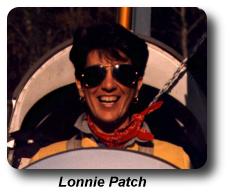
The group called its first meeting to call for Charter Members on August 24. Of the 40 individuals who had made verbal commitments to invest in the startup of the new club, 23 actually ponied up the money; the very first check, for $1300, was from Charles Ray. The first group of Acting Board of Directors was also named officers - Jim Postma, President; Lonnie Patch, Secretary; Bob Leyendecker, Vice President; Bela Gogos; Treasurer; Shane Neitzey; Membership Chief; and Leo Meacher; Operations Chief. (The summer and fall of 1991 were a bit tricky for Annear and myself - as Directors and Officers of the Company, were in the curious position of having to represent the Corporation in the negotiations with Shane's group which was forming the Club that we both intended to join and invest in!)
The founding members of Skyline were, myself, Spencer Annear, Shane Neitzey, Dick Ault, Bob Leyendecker, Leo Meacher, Jim Miles, Jim McCulley, Bela Gogos, Bill Wark, Charlie Lee, Fred Winter, Joe Rees, Ralph Popp, Bob Neff , Paul Dawson, Richard Matsko, Phil Jordan, Ray Charles, Ernie Snowden, Wirt Walker, Tom Phillips, Bill Westerman, and Kit Carson. Kit had been towing at WSC for years. One of the relatively few Club members who, fortunately for the Club, likes to fly the towplane more than the gliders, continues to be a regular tow pilot even since he retired and moved to Mineral, VA, where he lives with wife Marty. They drive a luxurious motorhome, so when he comes to FRR, they just park the home at the end of the hangar and fly all weekend!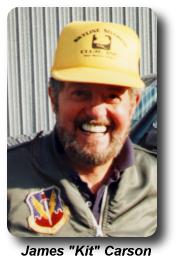
Founding member (and long term Treasurer) Bela Gogos learned to fly gliders as a teenager in Hungary. The picture shows him (second from right)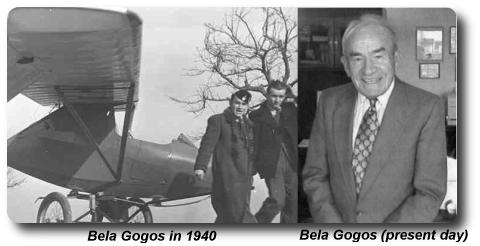 with the Air Academy's trainer in 1940. After the war, in which he flew Me-109s and many other military aircraft in the Luftwaffe, his Russian captors imprisoned him. He survived solitary confinement in the notorious Lubianka prison in Moscow and years of forced labor in a Soviet gulag before moving to Canada, where he met and married Susan, a Hungarian athlete who defected from the Olympic team. They moved again to the United States and raised a family, while having an outstanding career with IBM. He retired from IBM and with his retirement bonus, upgraded his ASW-19 to an ASW-20, which he still flies. In 1998 he personally funded the Gogos Scholarship program for young pilots, which is managed through the Collegiate Soaring Association. It has already funded several young men and women in several stages of their soaring career, helping Bela to share the passion that has so profoundly affected his personal life to another generation. In 1999, Bela and Susan were prominently featured on the front page of the Winchester Star. The article included excerpts from Bela's autobiography, which is being written as the year comes to a close.
The last newsletter of the Warrenton Soaring Center was published on September 22, 1991 (I was editor of the newsletter.) The first newsletter of the Skyline Soaring Club was published in November, 1991. It reported the raising of some $28,000 from non-interest bearing loans from a group of Charter Members. Most of the money was used to purchase the Pawnee the Club still flies. Skyline's first flight was at Warrenton Airpark, on November 23, 1991.
In the process of selling stuff off, the Company managed to foist the old Concord trailer onto the new Club. It didn't take long for the Club to realize the trailer was useless, so after much fumbling around, we managed to give it to the Salvation Army on July 1,1994. Spencer Annear took on the task of delivering the trailer to the Salvation Army, and on checking the tires for the move, found that two held air and two were rotted out. He had to jack the trailer up, remove the rotted tires, find used tires in Warrenton, have them mounted and reinstall them. He recalls lying in the grass working on the wheels and getting up to see a herd of wood ticks moving in. When the Army came to pull the trailer to northeast D.C. for the auction, he waited a while before starting out to see how things were going. Sure enough the truck and trailer were soon stopped by the road. That was a very tender pull up as the trailer was about to fall apart. Spencer went to the auction and saw the trailer sitting there, but did not wait to see it auctioned as there were about 50 cars, on the block, ahead of it. Somebody probably bought it for the frame and wheels as the top was pretty much dry rotted.
James Postma was the Club's first president, but he moved away shortly after it was founded. He was succeeded by Spencer Annear who led the club for the next six years during its critical youth. The Club's third President, Joe Rees, was elected in 1998. The Club's unique structure ? with an all-powerful Board that elects officers - was Annear's brainchild. I recall thinking it was really weird when we first put the Club together, but the concept was exactly right for a soaring club, reflecting the reality of how such Clubs actually get to be managed. A lot of the Club's success is due, in my opinion, to this structure and to the foresight that led to it, plus the consistent fiscal conservatism of Treasurer Bela Gogos. With the fortuitous leadership of these two people, the Club enjoyed managed growth and steady debt reduction, so that the Club will be debt free in the first few months of the year 2000.
By January, 1992, the fledgling Club had survived the purchase of the Pawnee and the 2-33, N2743H. It had also secured the agreement with the owners of the ASK-21 (Fred Winter and Bob Neff) to lease the ship to the Club on similar terms as the lease to WSC. The final acquisition was the lease of the SGS 1-36 from owners Ralph Popp and Joe Rees. (This is the Club fleet that remains as of this writing.) There were 36 members at the end of January.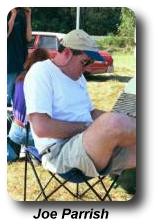
From the very beginning, the Club wrestled with the very same fundamental issues that had wracked all its predecessor organizations - shall it be primarily a training club? How much and what kind of equipment should it own? Where will it fly? How large should the membership be? Should we invest in public service activities (e.g., supporting the training of young people)? The early Board was influenced by the Club's origins in the Warrenton Soaring Center, which is partly responsible for today's emphasis on training. There was (and still remains) serious concern by the Club's leaders that the Club should not compete with commercial soaring FBOs, nor should it engage in any activity that threatens even slightly the Club's non-profit status (for compliance with applicable insurance, tax, and CFR requirements.) Still, training is a major component of the Club's activities as we enter the 21st century, as attested to by the baptism of still another member's first solo shown here (right)! Joe Parrish (left), one of the Club's currently active instructors, got his CFI(G) at a commercial gliderport in 1994 and soon became one of the Club's more active pilots. Shown here working on a lesson plan for a student, he now flies an LS-4.
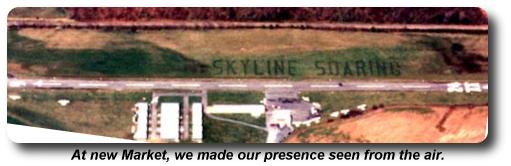
Scheduled operations began at FRR in March, but by the end of April, the Board approved a move to New Market Airport (8W2). There were several reasons for the move; one was the presence of some really obnoxious skydivers at FRR at the time, and the other was a lack of hangar space. (It's worth noting that shortly after the Club moved to 8W2, the skydivers crashed both their jump planes!) The founders of the Club were keenly aware of the importance of hangars, having lost thousands of dollars to maintaining both gliders and towplanes due to the effects of weather on tied-out aircraft. Kevin Fleet and I, using his computerized surveying equipment and several hundred pounds of fertilizer, marked 8W2 so that no overflying pilot would fail to know WE WERE THERE! (This picture was published in Soaring magazine.)
The New Market Airport has a history of its own that deserves some research that is beyond the scope of this work. When the Club moved there, it was owned and managed by one Ed Raney who lived on the airport property with his wife Linda and their two small children. To get right to the point, many people (such as myself) found his personality excessively abrasive. Ed's behavior caused the Club to lose several members - including myself (in the summer of 1992) Dick Ault, Bill Jones, and others. His unpredictable behavior was unsettling, to say the least, and I was (and still am) fearful for my safety around him.
Ed was convicted of tax fraud in 1995 and imprisoned. He escaped in 1997 but was returned to a prison somewhat more secure than the one from which he escaped. He is scheduled for release March 24, 2000.
But 8W2 had hangars! Not very fancy ones, but certainly affordable. And the Club benefited mightily from the fortunate circumstance that our Leo Meacher hit it off with Ed Raney. It was this relationship that enabled the Club to move there in the first place, and Leo's running interference with Ed made flying there palatable for the rest of the Club.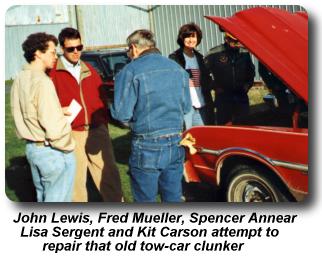
We even had a club car - an old clunker that Ed Raney had actually given the Club. We managed to get it running (you had to stick your finger in the hole where the ignition key was supposed to be fitted, feel for a peg, and push it hard to crank the thing!). Here, Skyliners John Lewis, Fred Mueller, Spencer Annear, Lisa Sergent, and Kit Carson ponder the next step(s) on one of its more recalcitrant days.
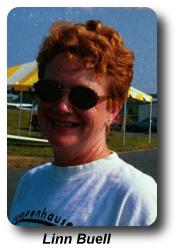
Linn Buell, CFI(G) and tow pilot, was one of the people who made weekday operations possible starting in 1997. (Linn flies an LS-4 in Florida (where she now lives) and a 1-26 in Germany.) While a member of Skyline, Linn was named Chair of the Board of Directors of the National Soaring Museum, and served as President of the Vintage Sailplane Association. Linn was one of the very active tow pilots (along with Jim McCulley, Fred Daams, and others) who made weekday operations possible.) Weekday flying made a big difference in the speed with which members learned to fly and triggered a sharp increase in Club income.
Chapter V -- Skyline Soaring Club, Front Royal
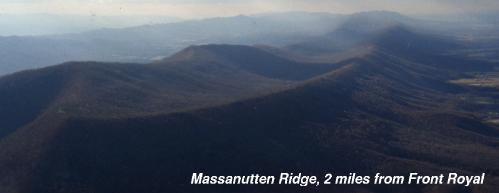
However, when one door closes, often another opens. That was certainly true in this case, since we actually wound up a rather nice airport, and one that shortened the drive for many Club members. The Club had, in its collective wisdom, already done a survey of alternate sites, so that study was dusted off and quickly led to the decision to relocate back to FRR. As it turned out, the management at FRR, Cass Aviation, and the Warren County Airport Commission had made it clear that they wanted us back, and the case was clinched when we learned in 1998 that FRR had hangars available. The airport (above, right) has a 3000 paved runway and a clear sod safety area 1700 feet long immediately adjacent. As you can see, there is also reasonable room for staging and parking areas. It's located just 4.4 NM from Signal Knob, the northern tip of the 45 mile long Massanutten range (left). This is a textbook ridge, and constitutes a 90 mile freebie on just about any cross country flight out of FRR.
The Airport Commission, then chaired by the same man (Charlie Brown) who used to operate a commercial glider program at Winchester, and the airport's management (Reginald Cassagnol, who used to have a commercial glider operation at FRR) were both experienced with gliders and their operations, so there were no surprises among the other users when we moved in.
We promptly rented five of their T-hangars (half of their total!), and the Commission promised to work with us by building, or allowing us to build, a new hangar more suitable for gliders. In the winter of 1998-1999, the Club enjoyed a sharp increase in membership and a huge increase in the size of the member-owned fleet of gliders, apparently a result (at least in part) of being closer to the Washington DC metropolitan center.
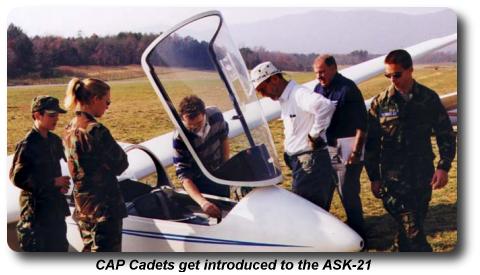
In the summer of 1999, the Club began to implement the provisions of the Civil Air Patrol - SSA Memorandum of Understanding. Under the leadership of Fred Hayman, a CAP Senior Member, a M-ASA towpilot and ex-WSC towpilot, the first orientation flights with cadets were made. I joined the CAP and by 2004, the Wing had obtained a brand new Blanik L-12, a USAFA surplus SGS 1-26, and a Maule towplane. Several Skyline members became very active in the CAP, including Eric Litt (the Wing's Operations Chief and, later, Wing Commander), Steve Lander (Director of Glider Operations), Dave Dawood (towpilot/CFI), Greg Ellis (O-ride pilot), and myself.
Skyline's involvement with the Civil Air Patrol continued with great success until the summer of 2008 when what appeared to be a microburst destroyed several aircraft, one of which was the Virgnia Wing's Blanik, on the ramp at the Culpeper airport. The Air Force refused to replace the glider, and even sold off the one-of-a-kind Maule with a Tost internal reel in it. With this major setback, CAP glider operations in Virginia ceased until, in 2012, a group of CAP glider enthusiasts in the Danville area obtained the resources to start up a small operation. Unfortunately, there was no involvement by members of the Club.
From time to time, the growing Club had re-visited the question of whether or not to buy more sailplanes. The Board steadfastly refused to consider purchasing additional gliders, although it encouraged members to purchase their own, either for their personal use or to lease to the Club. However, by 2002 member satisfaction with our aging 2-33 finally got to the point that it was replaced with a G-103, giving the Club two glass trainers. In 2004, the Club also purchased the SGS 1-36 that it had been leasing, and in ???? purchased a Cirrus from a retiring Club member, bringing the Club's fleet up to four - two trainers and two single place machines.
In 2006, the Club upgraded the engine in the Pawnee and installed a Hoffman four-bladed propeller. The resulting combination sharply reduced the noise (which had become a source of complaints from airport neighbors) without diminishing the performance. The towplane fleet also grew in number. In 2009, the Club purchased an Aviat Husky as a backup to the Pawnee, and to be used to train new towpilots. (It's ironic that, having made a large investment in reducing the noise in the Pawnee, that, three years later the much noiser Husky went unnoticed!)
The fleet of member owned gliders continued to grow - to twenty-two by 2014 - some based at Front Royal, and some based at other airports or stored at home.
It appears that this policy, often a difficult one to sell to the membership in the past, was beginning to pay off. The success of this policy illuminated the continuing shortage of hangar or storage space, and that had been exacerbated by the Airport Commission's reneging on it's original promises to build our own hangars, or to make additional hangars which they might build available to us. In fact, the Commission announced in 2002 its decision to build a large T-hangar complex! We worked with them to have added a larger hangar on one end, but were not involved in the final design, resulting in 2004 in the construction of a hangar that was quite inappropriate for gliders!
The Club was fortunate in 1999 to receive a lot of favorable publicity, some of which derived from a most unexpected (and tragic) event - the death of Bill Ivans and Don Engen in a glider crash. The Washington Post published a rather complementary article on July 21, 1999, and the Winchester Star did a similarly nice article on its front page that same week. The Northern Virginia Daily did a nice piece during the summer, and the star also did a very long and nice article on Club member Bela Gogos' life, including his ordeal as a Russian prisoner.
In late 2003, political differences between the Airport Commission and the political body (the Warren County Board of Supervisors) which appointed them reached a crisis. One of the Commissioners, Charles Brown, actually ran against one of the Supervisors, and lost. Within about six months, over half of the Commission, including its Chairman, which had actively sought our presence at Front Royal, had been replaced! The new Commission set out to meet the political agenda of the Supervisors, and held out considerable hope to the Club that we would finally be able to construct suitable hangars. However, that turned out to be a misplaced hope, since they proceeded to impose increasingly restrictive and costly changes in the airport's operation, making it clear that gliders - or at least the Club - were not seen as a part of the airport's future. The honeymoon was over.
There followed about a year of turmoil. The policies of the new Commission not only adversely affected the Club, but outraged the other tenants at the airport to the extent that an "Airport Users Community" was organized to lobby against the policies. After the community began to rally publicly for the tenants (including the Club), the Commissioners resigned, the Supervisors curtailed the authority of the Commission, and peaceful coexistence once again settled on the airport. By 2012, a Club member was actually appointed to the Airport Commission! What a dramatic change.
The club's "culture of safety" has served us well over the years, despite a few accidents, two of them involving fatalities. Our unique training program, rigorously promoting both safety and soaring proficiency, is thoroughly documented and has gained national recognition.
After over thirty years (this is written in 2021), we still struggle to reach consensus on "why we are", for example, just as the Warrenton Soaring Center did over three decades ago and M-ASA did five decades ago. Are we a training organization or a support organization for glider owners? Should we buy more equipment or encourage members to buy their own?
We face a more crowded airspace environment and a regulatory agency that continues to squeeze recreational aviation. Our membership is growing, and the percentage of soaring graybeards is shrinking. Glider ownership is growing very rapidly, putting pressure on the club to provide adequate services for this component, and the political leadership of the Airport Commission has dramatically changed.
We have a strategic plan - actually written down - and we have an organizational structure that has served us well during our formative years. We are located in an area proximate to a very desirable population base for a soaring Club, and with excellent soaring weather to boot.
We're still working hard to expand to other sites, and to eventually find a soaring site which we can own outright so as to develop it into a full-service soaring Club.
What happens in the twenty-first century, as soon as it happens, will be history. . . . "make it so"!